

Trump Pump Blues
Donald Trump and his Republicans were likely going to lose the House of Representatives. That history thing and all…
However, they lost BADLY not because of a slogan, a scandal or a debate.
They lost BADLY at the gas station.
On February 28, the day the war with Iran began, a gallon of regular cost $2.98.
May? $4.56.
On Election Day it was still $4.15, the highest Election Day price on record.
Diesel - which moves every grocery and every package, climbed past $6.
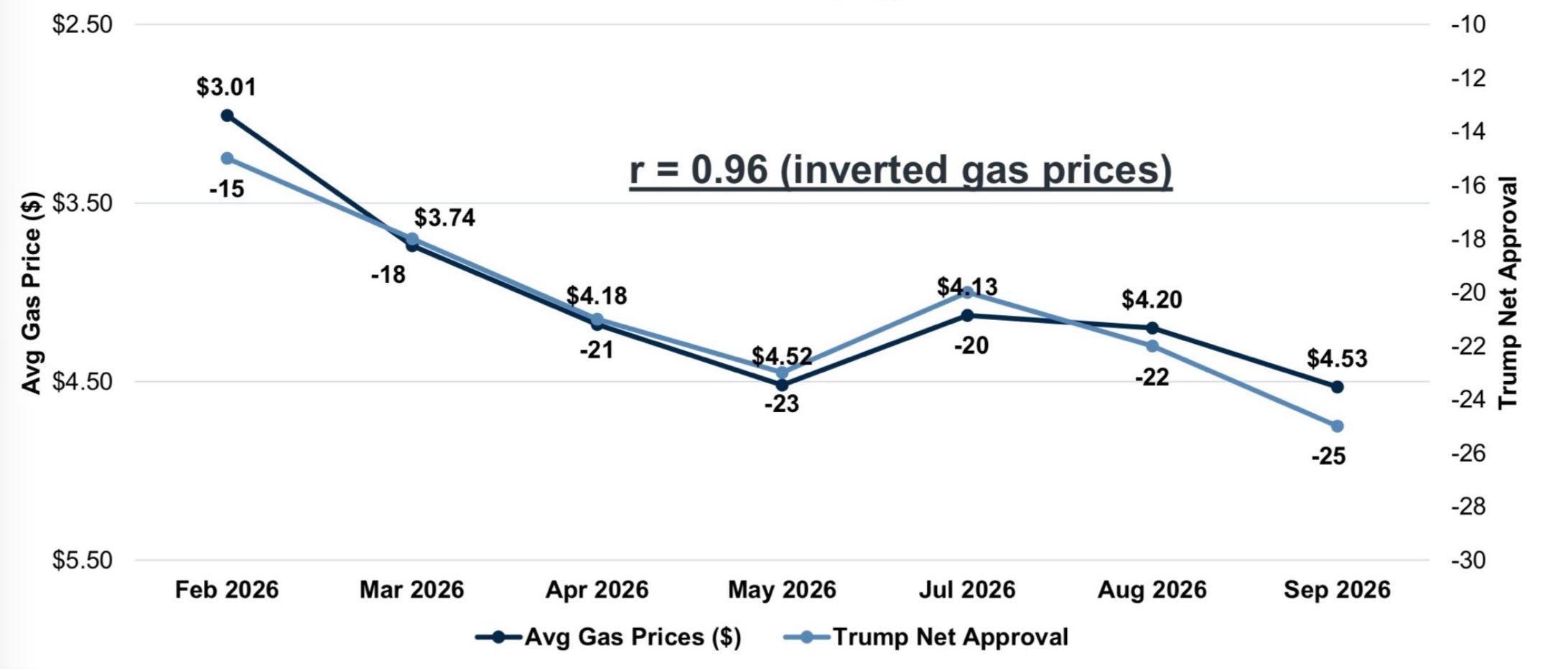
President Trump’s numbers followed the pump almost step for step.
His net approval was about minus 15 in early February. By Election Day it was about minus 25.
That is a 10-point slide, and it tracked gas prices the whole way down.
10 Points = the Senate and about 30 House seats
Here is the math.
While the President’s net approval fell 10 points, the national House vote moved from Democrats +4.8 on the generic ballot in late February to a final Democratic margin of about 13 points, the most lopsided midterm since 1974.
Every point of net approval was worth about eight-tenths of a point of margin or about 8 points toward Democrats.
In the House, forecasters put the value of each national point at about four seats. An 8-point swing is therefore worth roughly 30 to 33 seats.
Democrats are on track for about 255 seats. Without the gas-price slide, they would likely have finished near 222.
That is still a majority, but a bare one. The gas price slide accounts for most of Tuesday’s wave.
In the Senate, the stakes were higher. Six Democratic wins, five of them pickups, came in at 7 points or less:
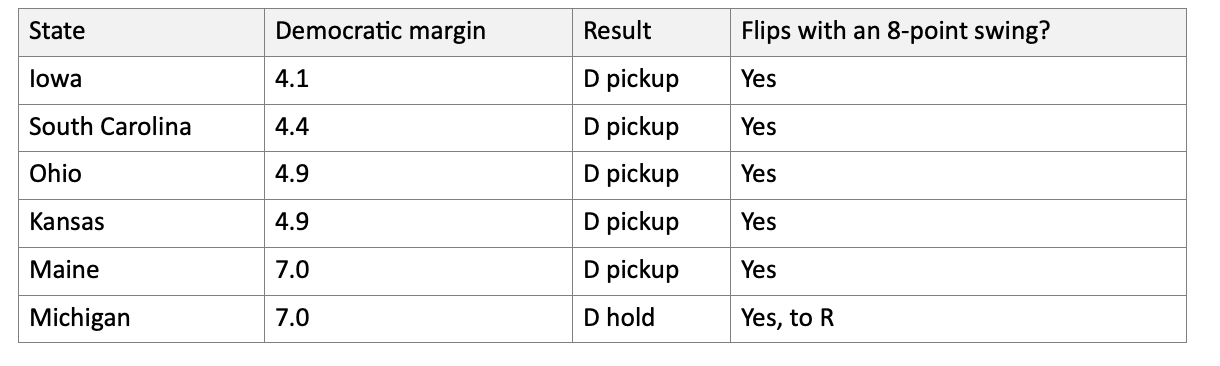
Alaska and Mississippi were still too close to call on Wednesday, with Democrats narrowly ahead.
A swing of even a point or two would have kept both Republican. North Carolina (Democrats +19.6), New Hampshire (+13.8) and Texas (about +12) would have held.
Put it together and Democrats fall from 54 seats to 48. Republicans keep the Senate 52–48 without needing Vice President Vance’s tiebreak.
This is a rough estimate.
It assumes a uniform swing, and gas prices were not the only thing voters disliked about the war.
Maine and Michigan sit right at the edge; with a 7-point swing they are coin flips, and Republicans still hold at least 50 seats plus the tiebreak.
Either way - the gas pump decided who runs the Senate.
Gas lit the fire - Tariffs, self-dealing, and silence fed it.
Tariffs piled on: Voters were told other countries would pay. They didn’t believe it, and they were right. By September, 74% of voters said the President’s tariffs had raised prices, and the Tax Foundation put the cost at about $820 per household this year.
Next time? Drop a bill and debate the issue.
Enrichment backdrop: While families cut back on groceries and vacations, the President’s family got richer. A crypto venture that barely existed when he took office reportedly made him about $1.2 billion in a year. In August, 63% of Americans told Reuters/Ipsos the family’s crypto profits were inappropriate.
63% = a LOT of Republicans.
Republicans couldn’t disagree: Voters told exit pollsters that Congress had not done enough to check the administration. DUH.
Republicans who spent years investigating the Biden family’s business dealings looked away from the Trump family’s.
Call the Balls and Strikes fairly or the public will call Bravo Sierra on you.
They did. Again.
Bad candidates cost everyone. Senate Republican leaders warned in the primary that Ken Paxton would be expensive to defend. They were right. GOP groups planned to spend $166 million for him in the final two months alone, more than in Michigan and Maine combined.
Counting the primary, the party’s tab in Texas topped $300 million.
Every dollar spent in Texas was a dollar not spent in Iowa, Ohio, Kansas, South Carolina or Maine. Those five seats were lost by 7 points or less.
It’s just math.
Ten Lessons (for both parties)
The pump is the poll. Voters see the price of gas every day, in numbers a foot tall. They see if they are winning or losing.
Every day. And feel it.
Tariffs are felt and seen, too. 75% of voters said tariffs raised their prices. #MathMathing
The party in power owns prices. 62% said high prices were more because of Trump’s policies than factors outside his control.
The economy, his #1 issue that carried him in 2024, became his biggest weakness. Asset to liability and he still doesn’t seem to care.
Foreign policy at the gas tank. Strait of Hormuz? Never been. War in Iran? Not much visual on the telly, but we saw the prices.
And still do.
Don’t promise what you can’t control. In May, with gas at $4.52, the President said prices would “drop like a rock” once the war ended.
Voters keep receipts it turns out.
The backdrop matters. Voters struggling with their bills watched the First Family’s fortune grow. Self-dealing. Americans HATE that. Always have.
A party that can’t disagree can’t protect itself. Republicans in Congress never called Bravo Sierra on their own. So the voters did it for them. #ZeroSympathy
Bad candidates cost more than their own race. Ken Paxton’s nomination cost Republicans more than $300 million in Texas. That was money that was not available to protect five other seats lost by 7 points or less. Cornyn is more moderate? But the GOP cheers on Susan Collins?
Money can’t outspend $4 gas. Republican-aligned groups spent about a LOT of money and it slowed the losses. Can you imagine how much worse/better it could have been?
Virginia, take note for 2027. All 140 General Assembly seats are on the ballot next year. Power bills, gas prices and the cost of living will matter. Candidates who think independently, and who have a credible plan to bring costs down, will win.
Status Update?
Energy prices going up related to policy, raising your own pay, and a brewing corruption scandal in self dealing.
Did someone say “that history thing and all…” at the beginning of this column?
#NotABlog
Bottom Line
Every election has a hundred explanations. This one has a chart. When gas went up, the President’s numbers went down, and the 10 points he lost were worth about 30 House seats and the Senate.
Tariffs, self-dealing, a party that would not say no and a Senate candidate who drained the war chest made a bad year worse.
The lesson is not partisan.
Whoever governs owns the cost of living, and whoever stays silent shares the blame.
For eight months the President stepped on the gas, his party watched with complicit silence, and Tuesday the voters, still sovereign, hit the brakes.
Sweet Virginia Breeze - Robbin Thompson
YOU DON’T SUBSCRIBE?
COME ON!!
THIS IS FREE.