

I’m not a fan of the CNBC Top States for Business methodology mainly because it changes from year to year. They also use 138 (+/- depending upon the year) different metrics.
Two metrics - where people and money are going - tell me what the market is actually doing.
Here are some operative pop culture references to help make my point:
Yogi Berra on why he doesn't go to a famous St. Louis restaurant:
“Nobody goes there anymore. It's too crowded."
Billy Beane in Moneyball
“If he’s a good hitter, why doesn’t he hit good?
Big Tom Callahan in Tommy Boy
"In auto parts, you're either growing or you're dying. There ain't no third direction."
Why just two metrics? Well, it’s objective, data centric, and easy to understand.
Let’s look at how those two metrics work out.
Do with it what you will.
<drumroll>
And the Top 17 States for Business are…
Where People and Money Are Going
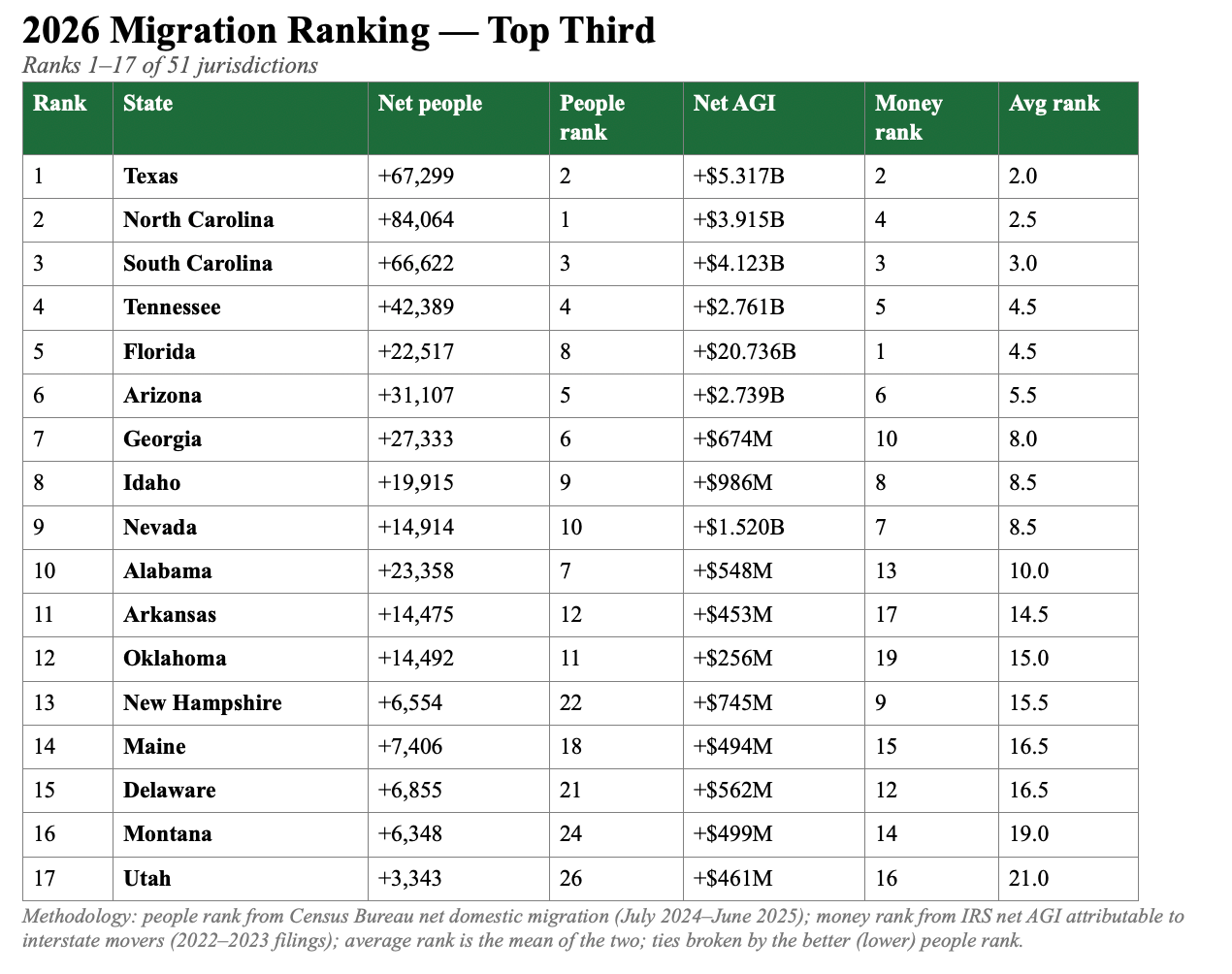
Two different scoreboards
This analysis combines two datasets:
People: latest Census Bureau net domestic migration, July 2024–June 2025 (Vintage 2025 population estimates).
Money: latest IRS interstate migration data, measuring the adjusted gross income (AGI) carried by taxpayers who moved between states, filing years 2022–2023.
The datasets cover different periods because IRS income data arrive with a lag.
Taken together, the pattern is clear: the South is leading both scoreboards.

The real story:
The Carolinas have Big Mo - mentum
The most interesting development is not Texas or Florida — it’s the emergence of North Carolina and South Carolina.
North Carolina added more domestic migrants than any state in the country in the latest Census year (84,064).
South Carolina posted the highest percentage population growth of any state (1.5%) and ranked third in raw numeric domestic migration.
The Carolinas increasingly combine the advantages that once drove the Florida and Texas booms: comparatively affordable housing, attractive smaller cities, strong job markets, and business growth.
Florida’s numbers may be even more important
Florida fell to eighth in current domestic migration (+22,517), down sharply from its post-pandemic peak (it gained over 300,000 net domestic migrants as recently as 2022).
Yet it attracted more than $20 billion in net annual adjusted gross income from interstate movers — nearly four times Texas’s gain, and the largest AGI inflow of any state by a wide margin.
Not all migrants are economically equal: a state can attract 80,000 new residents while another attracts a quarter as many people carrying substantially more income and investment capacity.
The Virginia angle
Virginia does not make the top third on either scoreboard. I will release that later.
Yeah, we need to talk.
And it’s not one of those good “we need to talk” talks.
And it’s not about Democrats or Republicans - I have criticized CNBC’s methodology for years regardless of who’s in office.
North Carolina, Tennessee, and South Carolina are increasingly Virginia’s most important economic competitors — not just for corporate relocations, but for the human and financial capital that seeds future businesses.