

Back to the Future
When Back to the Future came out 40 years ago in 1985, I watched in the theater wondering if life 30 years ago (1955) was actually like what the movie depicted. It was so…different.
It was also years before my parents even met
A total disconnect with then present-day 1985.
A LOT took place from 1955 to 1985, right?
Today, 30 years ago is 1995/96.
A 20 year old today (me/us in 1985) probably looks at 1995 the way we saw 1955 at the same age.
So…different.
Back to the Future centers on Marty McFly who goes back in time inadvertently disrupting his parents from falling in love thus jeopardizing his own creation.
McFly then tries to get his parents in position to fall in love at the dance where they had actually kissed for the first time.
Great movie.
Look, we cannot go back in time and undo policy mistakes over the last 30 years. Would that we could.
This is not the time for “I told ya sos” or recriminations; however, we have to deal with the consequences of those polices and hopefully teach the next generation what not to do going forward.
Failing to learn from history or some such.
Here’s the deal:
The Math is Mathing
In a country that trusts neither party, the winning message is honesty.
And the math is unavoidable now.
In housing that means - fix supply, face school costs, and name the rate-driven reality behind monthly payments.
Housing Supply, Affordability, and the Limits of Reform
The housing package up this morning in Senate Local Government is a meaningful and necessary step toward increasing supply, but it operates in a landscape shaped by forces far beyond zoning law.
Even strong supply reforms will not materially lower prices or monthly payments unless interest rates, local fiscal constraints, and demographic lock‑in also change.
A for Effort…but The Fed
The housing package should be given an A for effort.
Unfortunately for state level policy makers, the most powerful drivers of today’s housing affordability crisis were set at the federal and global level, not the local zoning board.
The bills proposed will help; however, it’s the political dynamic of the Gen X leaders that bears watching.
Entitlements?

Over the last generation, the Federal Reserve responded to successive crises with prolonged near-zero interest rates and repeated rounds of quantitative easing that inflated asset prices, including housing, far faster than incomes.
These policies rewarded leverage and ultimately locked millions of households into artificially low mortgage rates—reducing mobility and constraining supply when demand rebounded.
A Federal Reserve led by Kevin Warsh would likely seek to restore discipline by limiting emergency tools to true emergencies, shrinking the balance sheet more predictably, and re-centering price stability as the non-negotiable foundation of affordability.
Had monetary policy normalized sooner after the Global Financial Crisis—rather than remaining in crisis-mode for more than a decade—housing markets would be less volatile, less speculative, and far less sensitive to every swing in global interest rates today.
Generational, Not Partisan Reckoning
The housing conflict increasingly reflects a generational reckoning rather than a partisan one.
Baby Boomers benefited from decades of asset appreciation fueled by accommodative monetary policy, tax preferences, and land-use decisions that limited new supply once values were established.
Gen X - Dealing with Trade Offs
Having captured those gains, many now resist additional growth near them—objecting to density, infrastructure strain, and fiscal exposure—while younger households face higher prices, higher rates, and fewer entry points.
Gen X policymakers now sit in the middle: tasked with preserving community stability while correcting a system that protects incumbent wealth and shifts the costs of schools, infrastructure, and housing scarcity onto Millennials and Gen Z.
The political tension ahead is whether policy continues to shield accumulated equity or recalibrates toward mobility, affordability, and intergenerational balance.
Emerging Generational Tension
A defining political tension in the housing debate will increasingly be generational.
Gen X policymakers are now inheriting the results of Baby Boomer–era policy choices that prioritized asset appreciation, financial stability through monetary accommodation, and homeownership as a wealth-building vehicle.
As Boomers age in place—often constrained by capital gains taxes and ultra-low locked-in mortgage rates—housing turnover slows, supply tightens, and pressure shifts onto Gen X and Millennial families who must absorb higher costs.
The political conflict ahead is less left-versus-right than incumbent-versus-entrant: whether policy continues to protect accumulated wealth or recalibrates toward affordability, mobility, and intergenerational balance.
What This Legislative Package Accomplishes
• Increases housing supply elasticity so growth produces homes rather than bidding wars.
• Lowers marginal development costs through parking reform, ADUs, and manufactured housing parity.
• Redirects housing toward job‑rich corridors consistent with Smart Growth transportation policy.
• Makes housing production an administrative expectation rather than a purely discretionary local choice.
Why Prices and Monthly Payments Remain Elevated
Despite these reforms, housing prices and payments are still driven primarily by macroeconomic and fiscal constraints outside the reach of land‑use policy alone.
Bring Prices and Payments Down
• Interest rates: Mortgage rates dominate monthly payments; global bond volatility—including stress in Japan’s sovereign debt market—keeps long‑term rates elevated.
• School construction finance: New housing triggers costly school expansions that many local tax bases cannot absorb, discouraging approvals.
• Smart Growth imbalance: Transportation funding pushed growth toward job centers without sufficient by‑right housing capacity to match demand.
• Demographic lock‑in: Retirees and near‑retirees face capital‑gains exposure and low locked‑in mortgage rates, suppressing housing turnover.
• Infrastructure timing: Water, sewer, and road capacity often lag housing approvals, slowing delivery even where zoning allows growth.
Political Reality
Because these constraints span federal monetary policy, state infrastructure finance, and local fiscal capacity, partisan blame will persist even as supply reforms move forward.
Absent coordination across these layers, housing policy will continue to deliver incremental gains while the public demands immediate relief.
Bottom Line
This package is a good start—but appreciably lower housing prices and payments require aligned reforms in interest‑rate stability, school and infrastructure finance, and tax policies that unlock mobility alongside land‑use reform.
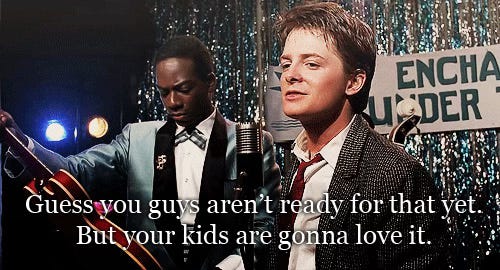
Hopefully policy makers will quote Marty McFly;
and let’s not forget Doc Brown:

Sorry, Doc…still going to need those.
Tracy Chapman warned in 1988:
Don’t you know
They’re talking about a revolution?
It sounds like a whisper
Don’t you know
Talking about a revolution?
It sounds like a whisper
While they’re standing in the welfare lines
Crying at the doorsteps of those armies of salvation
Wasting time in the unemployment lines
Sitting around waiting for a promotion
Don’t you know
Talking about a revolution?
It sounds like a whisper
Poor people gonna rise up
And get their share
Poor people gonna rise up
And take what’s theirs
Don’t you know you better run, run, run, run, run, run
Run, run, run, run, run, run
Oh, I said you better run, run, run, run, run, run
Run, run, run, run, run, run
‘Cause finally the tables are starting to turn
Talkin’ ‘bout a revolution
‘Cause finally the tables are starting to turn
Talkin’ ‘bout a revolution, oh no
Talkin’ ‘bout a revolution, oh
I’ve been standing in the welfare lines
Crying at the doorsteps of those armies of salvation
Wasting time in the unemployment lines
Sitting around waiting for a promotion
Don’t you know
Talking about a revolution?
It sounds like a whisper
And finally the tables are starting to turn
Talkin’ ‘bout a revolution
Yes, finally the tables are starting to turn
Talkin’ ‘bout a revolution, oh, no
Talkin’ ‘bout a revolution, oh, no
Talkin’ ‘bout a revolution, oh, no