

Virginia’s proposed move to end its data center sales and use tax (SUT) exemption eight years early is less about policy and more about predictability —and what happens as a result.
Two simple analogies bring this into focus: the neighborhood Happy Hour and the timeless scene of Lucy pulling the football away from Charlie Brown.
Happy Hour
Imagine a restaurant or bar advertising a daily happy hour—discounted drinks, lower prices on food - a clear incentive to come in and spend money.
Customers respond accordingly.
They change behavior, make plans, and spend money based on that expectation.
Now imagine the owner abruptly cancels Happy Hour halfway through the week—or worse, changes the rules after customers have already ordered.
Price or Predictability?
Both. But which one changes behavior more?
Predictability.
It’s one thing when a business changes prices, that happens all the time. It’s a perilous decision for sure as the business waits for the customer verdict.
Now, consider changing the price after customers have ordered and the food is being delivered.
<Restaurant Scene>
Server:
Oh, since you placed your order the owner lost money gambling on his new Casino Phone and he’s told us all to drop the Happy Hour prices, okay?
Customer:
Not okay. In fact, we’re not going to pay and you can keep your food and drinks, we’re leaving. AND we’re going to tell everyone one about it. Congratulations, you’re about to go viral.
Cue refrain from Alanis Morissette’s “You Outta Know”
Customers exit and pull out their Smart Phone (sans casinos) each taking turns posting their outrage du jour.
(Thanks, Dave)

<end scene>
Not a successful business model, right?
Data Centers
Data center investment works the same way, just at a much larger scale.
Virginia created an incentive structure designed to attract billions of dollars in long-term infrastructure investment.
It worked.
Actually - present progressive, not past tense - the incentive IS working.
(Yes, present progressive tense is ironic, but let’s focus here.)
Companies responded by building, financing, and committing to the Commonwealth based on those rules.
Those rules include the Sales and Use Taxes which factor into the business models on which decisions are made to finance.
The private sector can’t print its own money, it has to borrow it and have it in the bank in order to purchase the equipment and secure labor contracts.
These are not short-term decisions; they are multi-decade capital allocations involving complex financing models built on predictable cost assumptions.
Now consider the Lucy analogy.
AUGH!
Each time Charlie Brown lines up to kick the football, he trusts that Lucy will hold it in place. And each time, she pulls it away at the last second.
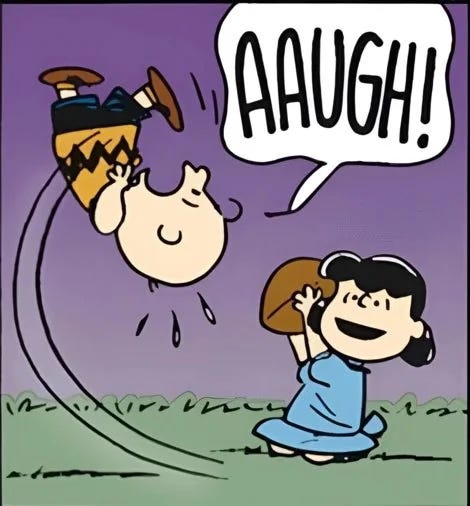
Eventually, the lesson isn’t about the missed kick—it’s about the expectation that the rules will change just when it matters most.
If Virginia changes its policy ahead of schedule, it risks becoming Lucy in the eyes of capital markets.
The current discussion has ALREADY hurt Virginia’s reputation as a reliable, predictable, and safe place to invest.
Repricing
The consequence is not immediate collapse, but repricing.
Investors begin to assume that incentives in Virginia are not durable.
Lenders demand higher interest rates because the RISK is higher.
Equity investors require higher returns. These can and do include public employee pension programs.
Projects that once penciled out no longer do. And perhaps most importantly, future investment starts to flow elsewhere—to jurisdictions where the football is more likely to stay in place.
Just as customers abandon a restaurant that plays games with its pricing, capital avoids markets that introduce uncertainty into long-term commitments.
The loss is not just the tax exemption—it is the erosion of Virginia’s reputation as a reliable partner.
In the end, the lesson is simple: incentives attract investment, but consistency sustains it.
Once a state signals that the terms of the deal can change midstream, every future deal carries a premium for that risk.
And like Charlie Brown, investors eventually stop running up to kick.
These next four weeks will be some of the most consequential in determining the next generation here in the Commonwealth.
Lewis Capaldi - Someone You Loved:
Hey, that’s just The Way It Is:
Speaking of Lucy…